Bel Royal Primary School
French
Intent
At Bel Royal, the intent of teaching French is to develop pupils’ confidence, curiosity and enjoyment in learning a foreign language, while building a strong foundation in vocabulary, grammar and phonics. We aim for pupils to leave Year 6 able to communicate simple ideas clearly, accurately and with increasing independence.
Our Intentions
- To develop listening, speaking, reading and writing skills progressively across KS2.
- To explicitly teach French phonics, enabling pupils to decode and pronounce unfamiliar language accurately.
- To build cumulative knowledge, where new learning links clearly to prior learning.
- To ensure pupils can use language purposefully through role play, songs, stories and real-life contexts.
- To foster a positive attitude towards languages and other cultures.
Curriculum Design
- Bel Royal’s French curriculum encompasses the three pillars to learning a Modern Foreign Language: vocabulary, grammar and phonics.
- The curriculum is carefully sequenced from Year 3 to Year 6
- Key language structures (e.g. j’ai / je n’ai pas, opinions, connectives) are revisited and extended.
- High-quality French stories and songs are used to support comprehension, pronunciation and cultural understanding.
- Language learning is seen as the interplay of vocabulary, grammar and phonics, rather than isolated strands.
Implementation
Lesson Structure (Consistent Across KS2)
Each lesson follows a clear and familiar structure:
1. Oral Warm-Up / Role Play
- Greetings, conversation rapides, recall of previous learning
- Builds confidence and automaticity
2. Explicit Teaching
- Introduction of new vocabulary, grammar or phonics
- Modelled pronunciation and choral repetition
3. Guided & Independent Practice
- Written, spoken or practical tasks
- Scaffolded to support all learners
4. Assessment for Learning
- Games such as Kahoot used to assess understanding in an engaging way.
Teaching Approaches
- Phonics-first approach: French sounds are explicitly taught and revisited (e.g. vowels, nasal sounds, digraphs).
- High-frequency structures are prioritised, so pupils can reuse language in different contexts.
- Role play and performance are central, encouraging purposeful communication.
- Repetition with variation ensures secure retention.
- Cross-curricular links (geography, PSHE, literacy) enhance meaning and engagement.
Adaptations:
To ensure accessibility for all pupils, the following adaptations are in place:
- Pre-teaching of key vocabulary using visuals and gestures
- Reduced language load (fewer words, simplified sentences)
- Sentence stems and speaking frames
- Choral repetition and partner rehearsal before independent speaking
- Matching, sorting and multiple-choice activities
- Adult support during role play and written tasks
- Use of songs, actions and rhythm to support memory
These adaptations ensure pupils can access the same learning intention while reducing cognitive load.
Challenge:
High-achieving pupils are challenged through:
- Extending sentences using connectives (et, mais, parce que, aussi)
- Justifying opinions with reasons
- Creating their own role plays or dialogues
- Writing short paragraphs using familiar language
- Manipulating language (changing tense, person or gender where appropriate)
- Acting as language models or peer supporters
- Applying language to unfamiliar contexts
This ensures high attainers deepen understanding rather than simply completing more work.
Impact
By the end of KS2, pupils:
- Can understand and respond to spoken French with confidence
- Pronounce language accurately using phonics knowledge
- Use familiar structures independently in speech and writing
- Show enjoyment and confidence in speaking French
- Are well-prepared for KS3 language learning
Assessment and Evidence
- Ongoing formative assessment through questioning, role play and Kahoot quizzes
- End-of-unit recap and revision sessions
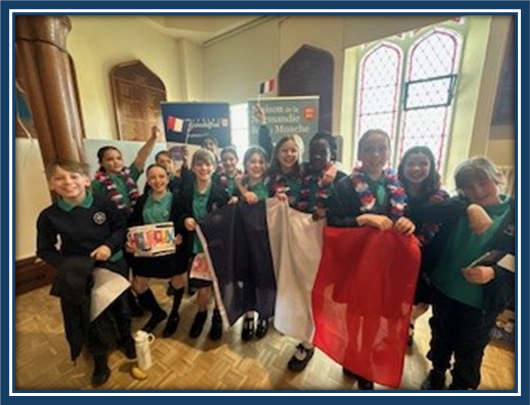
- Performance opportunities (e.g. conversation rapides, assemblies, French Eisteddfod)
- Work in books shows progression in vocabulary, sentence structure and accuracy
Pupil Voice and Engagement
- Pupils are confident to speak aloud and perform in French
- Lessons are inclusive, engaging and active
- Pupils can talk about how French phonics help them pronounce new words
Overall Impact: The French curriculum enables pupils of all abilities to succeed, builds strong foundations in phonics and language structures, and creates confident, enthusiastic language learners.
In Years 5 and 6, pupils are offered the chance to perform in the French Eisteddfod, with notable success in both the song and poem recital classes over the years.